Item enchanting is used to increase Item Power, also known as IP. Higher IP improves many of the most important equipment attributes: weapon damage, healing power, shield values, maximum Health, Energy, Armor, Magic Resistance, and other numerical values that scale with Item Power.
Not every property of an ability increases with IP. Range, cooldown, the number of targets hit, or the way a spell works usually remain unchanged unless the ability description states otherwise. IP primarily increases the numerical values of an item and its abilities.
Enchanting is performed at the Artifact Foundry, using the item-enchanting module. You can upgrade weapons, chest armor, helmets, shoes, capes, bags, off-hands, and gathering equipment from Tier 4 onward.
With Albion Online Item Enchanting Guide you do not need any crafting specialization to do this. You only need the correct item and the required number of Runes, Souls, or Relics of the same tier.
Example:
- a T5 item requires T5 materials;
- a T7 item requires T7 materials;
- you cannot use T6 Runes to enchant a T5 or T7 item.
Enchanting can be a good way to save Silver, but it is not always more profitable than buying a finished item. Sometimes the base item is cheap, but Runes are expensive. At other times, players list a finished enchanted item for less than the total cost of upgrading it yourself.
For this reason, before enchanting more expensive equipment, always compare:
- the price of the base item;
- the price of the required Runes, Souls, and Relics;
- the price of the finished item;
- prices in different cities;
- selling costs and taxes;
- other tier and enchantment combinations that provide similar IP.
Enchanting and Item Quality – They Are Not the Same
New players often confuse the enchantment level with item quality. These are two separate systems.
Enchantment is shown by the number after the decimal point:
- 5.0 – an item without enchantment;
- 5.1 – the first enchantment level;
- 5.2 – the second enchantment level;
- 5.3 – the third enchantment level;
- 5.4 – the fourth enchantment level.
Item quality can be:
| Quality | Additional Item Power |
|---|---|
| Normal | +0 IP |
| Good | +20 IP |
| Outstanding | +40 IP |
| Excellent | +60 IP |
| Masterpiece | +100 IP |
Each enchantment level adds 100 base IP, while quality adds between 0 and 100 IP independently of enchantment. This means that, for example, a Normal-quality 6.1 item and a Masterpiece-quality 6.0 item can have similar base Item Power, even though they are obtained in completely different ways.
You can attempt to improve item quality with Silver at the Repair Station. Quality rerolling is random, so it is easy to spend more than the price difference between finished items available on the market.
Before rerolling item quality, check the market first. Buying an Excellent-quality item is often cheaper than repeatedly rerolling the quality of your own item.
Equipment Enchanting Requirements
Enchanting regular equipment uses three types of materials:
- Runes to upgrade from x.0 to x.1;
- Souls to upgrade from x.1 to x.2;
- Relics to upgrade from x.2 to x.3.
The system works as follows:
- x.0 → x.1 – Runes;
- x.1 → x.2 – Souls;
- x.2 → x.3 – Relics;
- x.3 → x.4 – cannot be performed at the Artifact Foundry.
Items with .4 enchantment are created directly during crafting by using .4 enchanted materials. You cannot buy an 8.3 item and upgrade it to 8.4 with Relics or any other material.
To upgrade an item from 6.0 to 6.3, you must complete all three stages:
- 6.0 → 6.1 using T6 Runes;
- 6.1 → 6.2 using T6 Souls;
- 6.2 → 6.3 using T6 Relics.
You cannot skip an earlier enchantment level.
Number of Materials Required for Enchanting
The number of materials depends on the type of item being enchanted.
| Equipment type | Materials required for one enchantment level |
|---|---|
| One-handed weapon | 288 |
| Two-handed weapon | 384 |
| Chest armor | 192 |
| Bag | 192 |
| Helmet | 96 |
| Shoes | 96 |
| Cape | 96 |
| Off-hand | 96 |
The same quantities apply to Runes, Souls, and Relics. Only the material used at each stage changes.
Example of Enchanting a Helmet from 5.0 to 5.3
You need:
- 96 T5 Runes;
- 96 T5 Souls;
- 96 T5 Relics.
Example of Enchanting a Two-Handed Weapon from 7.0 to 7.2
You need:
- 384 T7 Runes;
- 384 T7 Souls.
Example of Enchanting Five Chest Pieces from 6.1 to 6.2
One chest piece requires 192 T6 Souls.
Five chest pieces require:
5 × 192 = 960 T6 Souls
When enchanting a larger number of items, even a small difference in the unit price of a material can change your profit by hundreds of thousands of Silver.
How to Enchant an Item Step by Step
- Buy or prepare the item you want to upgrade.
- Check its tier and current enchantment level.
- Buy the correct Runes, Souls, or Relics of the same tier.
- Go to the Artifact Foundry.
- Open the item-enchanting module.
- Place the item in the correct slot.
- Check the cost and the required number of materials.
- Confirm the upgrade.
- Compare the new value of the item with the market price of the finished equivalent.
Enchanting does not change the item type or its abilities. The item also keeps its quality. If you enchant an Excellent-quality 5.0 item, you will receive an Excellent-quality 5.1 item.
Item Enchanting Results
Each enchantment level adds 100 base Item Power.
For this reason, the following combinations are at a similar level in terms of base IP:
| Effective tier | Example equivalents |
|---|---|
| 5 | 5.0, 4.1 |
| 6 | 6.0, 5.1, 4.2 |
| 7 | 7.0, 6.1, 5.2, 4.3 |
| 8 | 8.0, 7.1, 6.2, 5.3, 4.4 |
| 9 | 8.1, 7.2, 6.3, 5.4 |
| 10 | 8.2, 7.3, 6.4 |
| 11 | 8.3, 7.4 |
| 12 | 8.4 |
The simplest way to calculate the effective tier is:
tier of the item + enchantment level
Examples:
- 5.2 has an effective tier of 7;
- 6.3 has an effective tier of 9;
- 8.1 has an effective tier of 9;
- 4.4 has an effective tier of 8.
However, this does not mean that every 5.3 item is practically identical to an 8.0 item.
Final IP is also affected by:
- quality;
- character specialization;
- the higher-tier Mastery Modifier;
- artifact type;
- the additional base Item Power of a particular equipment line.
Higher tiers have a greater Mastery Modifier, which increases the IP gained from specialization. For this reason, a well-developed character can achieve a slightly different final result with an 8.0 item than with a theoretically equivalent 5.3 item.
Higher-tier items can also unlock abilities that are not available on lower tiers. For this reason, do not compare equipment only by its effective tier.
Base Item Power Table by Tier and Enchantment
The following table shows the base IP of regular items without additional bonuses from quality, specialization, or the Mastery Modifier.
| Combination | Base IP |
|---|---|
| T4.0 | 700 |
| T5.0 / T4.1 | 800 |
| T6.0 / T5.1 / T4.2 | 900 |
| T7.0 / T6.1 / T5.2 / T4.3 | 1000 |
| T8.0 / T7.1 / T6.2 / T5.3 / T4.4 | 1100 |
| T8.1 / T7.2 / T6.3 / T5.4 | 1200 |
| T8.2 / T7.3 / T6.4 | 1300 |
| T8.3 / T7.4 | 1400 |
| T8.4 | 1500 |
A bonus based on the artifact type is added to this value:
| Item type | Additional base IP |
|---|---|
| Regular item without an artifact | +0 |
| Royal Sigil | +25 |
| Rune Artifact | +25 |
| Soul Artifact | +50 |
| Relic Artifact | +75 |
| Mists Artifact | +75 |
| Avalonian Item | +100 |
| Crystal Item | +100 |
Example:
A regular 6.1 item has 1000 base IP.
A 6.1 Relic Artifact can have:
1000 + 75 = 1075 base IP
Quality and IP gained from specialization are then added to this value.
Item Enchanting and Equivalent Item Comparison Calculator
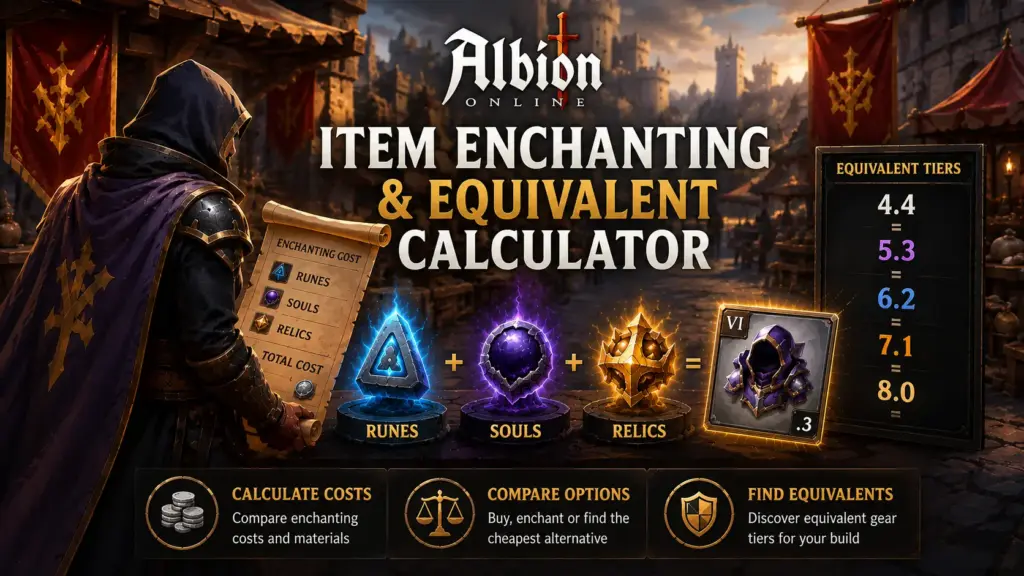
Manually checking the price of the base item, Runes, Souls, Relics, and every equivalent combination quickly becomes tiring. This is especially true when you are comparing several cities or want to enchant a larger number of items.
For this reason, before buying materials, use:
Item Enchanting and Equivalent Item Comparison Calculator
The calculator allows you to compare:
- buying a finished enchanted item;
- buying a base item and enchanting it yourself;
- the cost of progressing through several enchantment levels;
- the required number of Runes, Souls, and Relics;
- material prices in individual cities;
- the cost within a single city;
- a mixed option using purchases from different markets;
- equivalent tier and enchantment combinations;
- the cheapest way to obtain the required equipment level;
- the difference between the cheapest and most expensive option.
For example, instead of automatically buying an 8.1 item, you can compare it with:
- 7.2;
- 6.3;
- 5.4.
The calculator also shows whether it is more profitable to buy a finished item or upgrade a cheaper item by using Runes, Souls, and Relics. Items with .4 enchantment are compared as finished or directly crafted items because they cannot be obtained through normal enchanting.
Can You Make Money by Enchanting Items?
Yes, but this does not mean enchanting the first item you find on the market.
Making money from enchanting works when the combined total of:
- the base item price;
- the cost of Runes, Souls, and Relics;
- market fees;
- transport costs;
- the tax paid after the sale;
is lower than the amount you receive for the finished item.
The simplest formula is:
profit = sale price after fees – total purchase and enchanting cost
Example
Assume that:
- a 6.0 item costs 70,000 Silver;
- the required T6 Runes cost 25,000 Silver in total;
- a 6.1 item can be sold for 125,000 Silver;
- fees and taxes will cost 10,000 Silver.
Your actual profit is:
125,000 – 70,000 – 25,000 – 10,000 = 20,000 Silver
If you sell ten such items, the potential profit is 200,000 Silver. The problem is that the price may fall before all the items are sold.
Which Items Should You Look for When Enchanting for Sale?
The best items are those that are:
- regularly used in popular builds;
- lost in large quantities in PvP;
- purchased for group PvE, HCE, the Mists, ZvZ, or ganking;
- highly liquid on the market;
- sold with a large price difference between the base and enchanted versions;
- available cheaply in one city and more expensively in another;
- enchanted using inexpensive materials.
Do not look only at the theoretical profit from one item.
An item may show a profit of 100,000 Silver, but if it sells only once per week, your capital will be frozen and other players will continuously undercut you.
A smaller profit on an item that sells several times per day is better.
Buy Orders Instead of Instant Purchases
The largest margins are usually achieved through buy orders.
You can place buy orders for:
- base items;
- Runes;
- Souls;
- Relics.
If you buy all the components immediately from sell orders, you give part of the potential profit to players listing them at higher prices.
However, remember the time involved. If you must wait several days to collect the materials and the price of the finished item falls during that period, the earlier calculation is no longer current.
Compare Cities
Prices of Runes, Souls, and Relics can differ significantly between cities. The same applies to finished equipment.
It may happen that:
- the base item is cheapest in Thetford;
- Relics are cheapest in Martlock;
- the finished item sells best in Caerleon.
This type of trading can increase your profit, but you must include:
- transport time;
- transport risk;
- the cost of the mount and transport set;
- the possibility that the price changes before the item is sold.
The cheapest option on paper is not always the best one if it requires transporting an expensive load through red or black zones.
Enchanting and Crafting Items from Enchanted Materials
An enchanted item can be obtained in two main ways:
- craft it directly from enchanted refined resources;
- craft or buy the .0 version and enchant it at the Artifact Foundry.
There is no single answer as to which method is always cheaper.
When crafting from enchanted materials, the following factors matter:
- material costs;
- the city’s local production bonus;
- resource return rate;
- Focus Points;
- crafting specialization;
- station usage fees;
- the quality of the crafted item.
When enchanting a finished item, the following factors matter:
- the base item price;
- the price of Runes, Souls, and Relics;
- price differences between cities;
- the price of the finished enchanted version.
For a single item, it is often easier to buy a cheap base version and upgrade it. In mass production, a well-developed crafter may achieve a better result by crafting directly from enchanted materials.
Enchanting Food
Food does not use IP in the same way as weapons and armor. Enchantment directly increases the strength of the food’s effect.
Enchanted food is created during production at the Cook. Finished .0 food cannot be taken to the Artifact Foundry and upgraded to .1.
The following materials are used to enchant food:
- Basic Fish Sauce for .1;
- Fancy Fish Sauce for .2;
- Special Fish Sauce for .3.
Fish Sauces are produced from Chopped Fish and Seaweed. The amount of sauce required depends on the specific recipe and food tier.
Enchanted food can provide:
- a greater damage bonus;
- more maximum Health;
- stronger cooldown reduction;
- increased carry capacity;
- a stronger gathering bonus;
- a stronger combination of several effects.
Before production, compare the price of regular food, the Fish Sauce, and the finished enchanted version. Some foods are popular in PvP and sell quickly, while others have very low turnover.
Enchanting Potions
Potions can be enchanted up to .3 during production at the Alchemist’s Lab.
Arcane Extract is used to strengthen them. Arcane Extract should not be confused with the former Arcane Essences—they are different items and serve different purposes. Potion enchanting using Arcane Extracts was introduced with the alchemy expansion in the Wild Blood update.
As with food, a finished .0 potion cannot later be upgraded at the Artifact Foundry. You select the enchantment level while crafting it.
Enchantment can increase, among other things:
- healing value;
- the amount of Energy restored;
- Poison strength;
- Resistance value;
- the duration or effectiveness of a particular effect.
The exact result depends on the type of potion.
Items That Cannot Normally Be Enchanted
Not every item with a tier designation supports enchanting.
The following items cannot normally be enchanted:
- mounts;
- furniture;
- decorations;
- construction items;
- gathering tools.
Gathering equipment, meaning gathering headgear, chest pieces, and shoes, can be enchanted from T4 in the same way as other equipment.
A gathering tool is a separate category. A higher-tier tool improves gathering speed and allows you to gather higher-tier resources, but you cannot upgrade it with Runes, Souls, or Relics.
Item Enchanting Is Available at the Artifact Foundry
Enchanting is performed at the Artifact Foundry, using the module responsible for item enchanting.
The Artifact Foundry is available in cities, including:
- Thetford;
- Bridgewatch;
- Martlock;
- Fort Sterling;
- Lymhurst;
- Caerleon;
- Brecilien;
- Merlyn’s Rest;
- Morgana’s Rest;
- Arthur’s Rest.
Artifact Foundries are also available in Portal Towns leading to the Outlands.
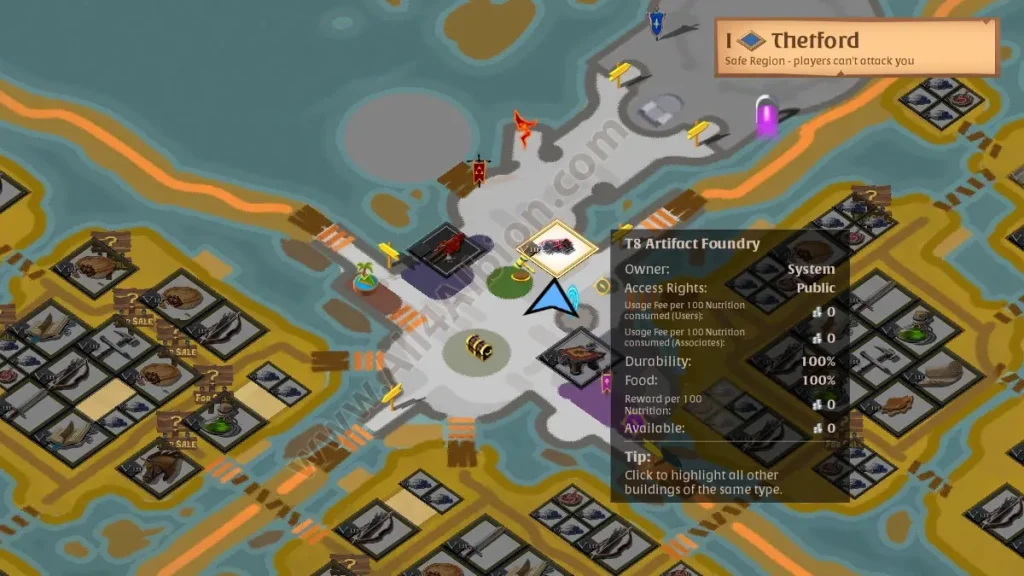
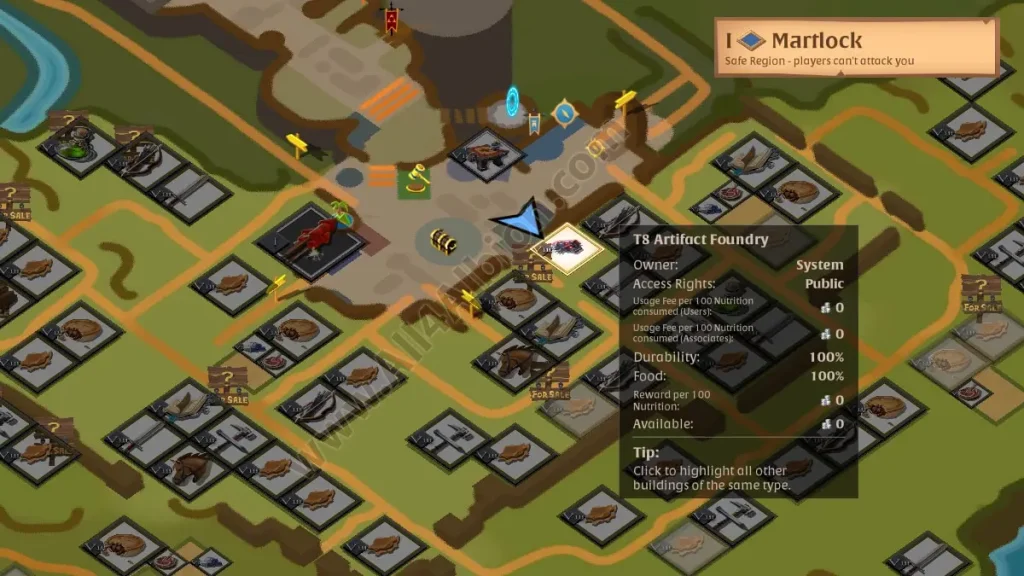
Look for the distinctive Artifact Foundry icon on the city map. The same building is also used to meld Runes, Souls, and Relics into Artifacts and for other systems related to Artifacts.
Artifact Foundry in Thetford
Artifact Foundry in Bridewatch

Artifact Foundry in Martlock
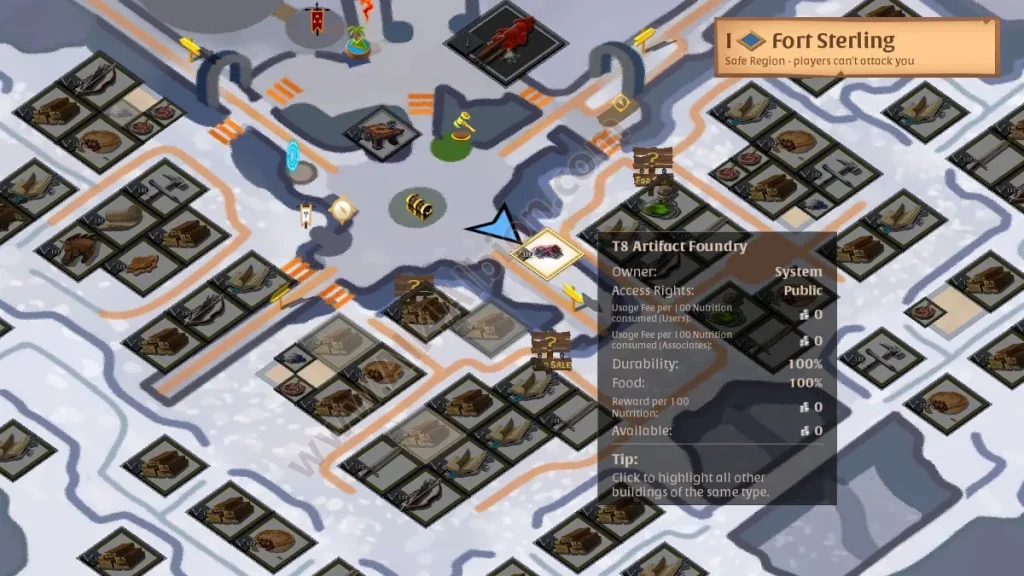
Artifact Foundry in Fort Sterling
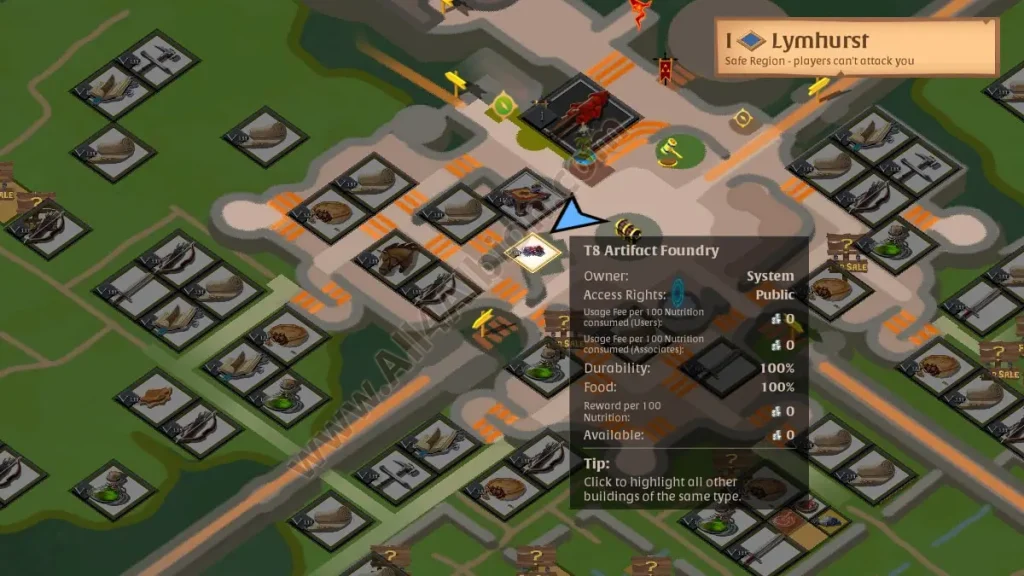
Artifact Foundry in Lymhurst
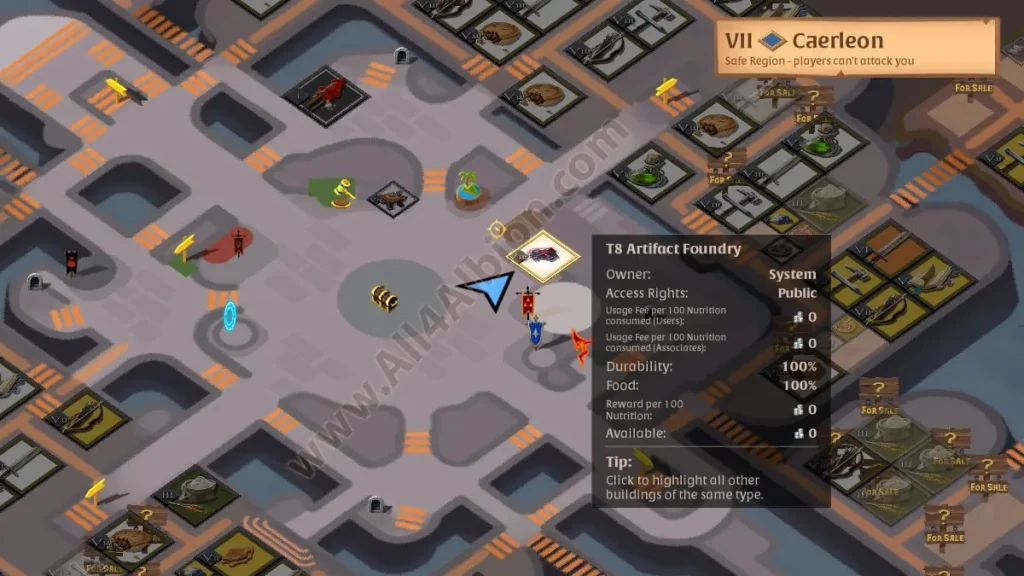
Artifact Foundry in Caerleon
Where Can You Find the Artifact Foundry in a Guild Hideout?
The Artifact Foundry appears in a Hideout after it has been upgraded to Level 3. It is not a separate building manually placed on a plot, but one of the functions available in a sufficiently developed Hideout.
It is not worth giving one fixed price for upgrading a Hideout to Level 3. The actual cost depends on the current requirements, materials, transport, power, and the guild’s situation.
For a regular player, it is much easier to use a public Artifact Foundry in a city or Portal Town.
Repair Costs of Enchanted Items
The higher the value of an item, the more you will pay to repair lost durability.
For a comparable regular item of the same type, each additional tier or enchantment level increases its cost class. For this reason, items with the same effective tier may have similar base repair costs.
An example group of equivalents:
- 8.0;
- 7.1;
- 6.2;
- 5.3;
- 4.4.
This does not mean that every one of these items will always have exactly the same repair cost. The following factors also matter:
- the item slot;
- the artifact category;
- the item’s base value;
- the amount of durability lost.
Rune, Soul, Relic, Crystal, and Avalonian Artifacts may have different repair costs despite having similar IP.
Quality does not increase repair costs. A Masterpiece-quality item receives an additional 100 IP, but you do not pay a higher repair rate for this bonus. The cost increases linearly with lost durability and can be checked by hovering over the durability indicator.
This is one of the reasons why a high-quality item can be a good way to increase IP without increasing repair costs. However, you should first check whether its purchase price is not significantly higher than a cheaper item with the next enchantment level.
The Most Common Item Enchanting Mistakes
Enchanting Without Checking the Price of the Finished Item
This is the most common mistake.
A player buys a cheap 6.0 item, purchases Runes, and only after enchanting notices that the finished 6.1 item was cheaper.
Always calculate the full cost before confirming the upgrade.
Buying All Materials Immediately
When dealing with a larger number of items, buy orders can significantly reduce the cost.
Instant purchases are convenient, but they often consume most of the margin.
Confusing Quality with Enchantment
Masterpiece does not mean .4.
Masterpiece quality provides +100 IP, but the item can still be 5.0, 5.1, or 8.3.
Trying to Enchant an Item to .4
Normal enchanting can only reach .3.
A .4 item must be crafted directly from .4 materials.
Using Materials of the Wrong Tier
A T7 item requires T7 Runes, Souls, or Relics.
Cheaper T6 materials will not work.
Ignoring Market Liquidity
A high margin does not matter if the item does not sell.
Check the number of offers, price history, and sales frequency.
Failing to Include Taxes
The price shown on the market is not the same as the amount of Silver that will ultimately remain in your wallet.
Deduct listing fees and sales tax.
Enchanting Too Many Items at Once
The market reacts to supply. Listing dozens of identical items can start a price war and reduce the margin.
At the beginning, test a few items at a time.
Practical Tips for New Players
- Do not automatically sell every Rune, Soul, and Relic obtained from dungeons. First check whether you can use them to prepare your own set more cheaply.
- For inexpensive PvP, it is often more profitable to buy a flat item and enchant it yourself.
- For PvE, compare different effective-tier combinations. Instead of 8.0, 6.2 or 5.3 may be sufficient.
- Check whether the required ability is available on the lower tier. A cheaper IP equivalent will not help if it does not have the required spell unlocked.
- Pay attention to quality. Sometimes an Excellent-quality item costs only slightly more than a Normal-quality item.
- Calculate expensive Artifacts separately. Do not compare them directly with regular equipment based only on the tier number.
- When trading, compare prices in at least several cities.
- If the profit depends on buying materials at an exceptionally low price, do not treat it as guaranteed.
- Do not transport an expensive load through dangerous zones without a suitable transport set.
- Keep a reserve of Silver. Do not invest your entire wealth in one batch of items.
Summary Albion Online Item Enchanting Guide
Enchanting allows you to increase Item Power without having to buy equipment of a higher tier.
Enchanting uses:
- Runes for x.0 → x.1;
- Souls for x.1 → x.2;
- Relics for x.2 → x.3.
Each enchantment level adds 100 base IP. Items with .4 enchantment are not created through normal enchanting—they must be crafted directly from .4 materials.
Enchanting can be:
- a way to prepare your own set more cheaply;
- a method of comparing equivalent tiers;
- an additional source of profit;
- a way to use Runes, Souls, and Relics obtained during gameplay.
However, do not assume that upgrading an item yourself is always cheaper.
Before every larger purchase, compare the finished item, every enchanting stage, and equivalent equipment options by using:
Item Enchanting and Equivalent Item Comparison Calculator
A properly calculated difference between the price of the base item, the materials, and the finished equipment can save a large amount of Silver. On a larger scale, the same knowledge allows you to make money by preparing items that other players do not want or do not know how to price themselves.